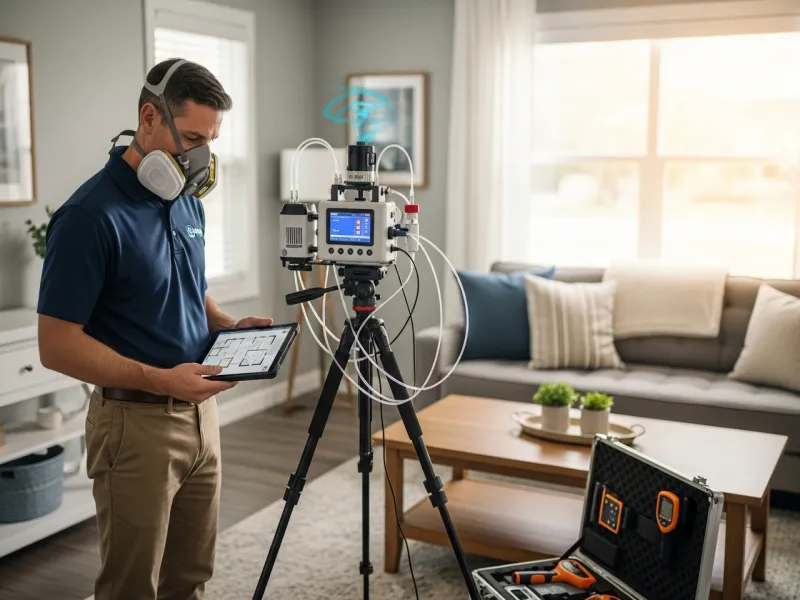
Experiencing unexplained allergies, persistent coughing, or musty odors in your Fort Worth home? Airborne mold spores could be the hidden culprit affecting your family's health. Our team provides professional air quality mold testing that detects invisible threats floating through your indoor environment. With years of experience serving Tarrant County homeowners, our certified inspectors use calibrated spore trap cassettes and impaction samplers to capture precise air samples from multiple zones in your property. Whether you suspect hidden mold behind walls or simply want peace of mind about your indoor air, our thorough testing process delivers lab-certified results you can trust. Call 940-240-6902 to schedule your air quality assessment today.
What Is Air Quality Mold Testing?
Air quality mold testing uses calibrated sampling equipment to capture airborne spore samples from your indoor environment, which are then analyzed by an accredited laboratory to identify mold species and concentration levels compared to outdoor baselines.
Air quality mold testing, also known as airborne spore sampling, measures the concentration and types of mold spores present in your indoor air compared to outdoor baseline levels. Professional inspectors collect air samples using specialized pumps that draw a measured volume of air through collection cassettes, capturing microscopic spores for laboratory analysis. This testing method reveals hidden mold problems that visual inspections alone cannot detect—mold growing inside wall cavities, above ceiling tiles, or within HVAC ductwork releases spores into circulating air long before visible growth appears. Homeowners typically need air quality testing when they notice persistent musty smells, experience worsening respiratory symptoms indoors, or after water damage events that may have created concealed moisture problems.
Air Quality Mold Testing Process: How We Work
1
Pre-Inspection Consultation
We discuss your concerns, health symptoms, and any known moisture issues. This helps us target sampling locations and identify potential problem areas before arriving at your property.
2
Outdoor Baseline Sample
An outdoor air sample establishes normal background spore levels for your area. This critical reference point allows the laboratory to determine whether indoor levels are elevated above what's expected naturally.
3
Indoor Air Sample Collection
Using Bio-Pump Plus samplers and Air-O-Cell cassettes, we collect air samples from areas of concern and common living spaces. Each sample draws a precise volume of air through the collection media over a timed period.
4
HVAC System Sampling
We sample air near supply registers and return vents to evaluate whether your heating and cooling system is distributing mold spores throughout your home—a common pathway for contamination spread.
5
Sample Chain of Custody
All samples are labeled, documented with location details, and sealed in tamper-evident packaging. A formal chain of custody form accompanies samples to the accredited laboratory.
6
Laboratory Analysis
An AIHA-accredited lab examines samples under microscopy to identify mold genera and quantify spore concentrations per cubic meter of air. Results typically arrive within 1-3 days.
7
Results Review & Report
You receive a comprehensive written report with spore counts, species identification, indoor-to-outdoor comparisons, health risk context, and specific remediation recommendations if elevated levels are found.
✓
Independent & unbiased results. Our certified inspectors focus on testing only -- never affiliated with remediation. Our team serves 31 DFW cities with lab-verified mold assessments.
Our Air Quality Mold Testing Options
Spore Trap Air Sampling
The most common method using cassettes that capture spores on a sticky collection surface. Provides genus-level identification and quantitative spore counts per cubic meter of air.
Best for: General indoor air quality assessments and identifying the most common mold types present in living spaces.
Culturable Air Sampling
Air is drawn onto nutrient agar plates that allow captured spores to grow into identifiable colonies. This method identifies mold to the species level rather than just genus.
Best for: Situations requiring species-level identification, such as determining whether Stachybotrys chartarum (black mold) is present versus less harmful species.
Real-Time Particle Counting
Digital particle counters measure total particulate levels in real-time, providing instant feedback on air quality without waiting for lab results.
Best for: Preliminary screening to identify rooms with elevated particulate levels before conducting more targeted laboratory sampling.
MVOC Testing
Microbial Volatile Organic Compound testing detects gaseous byproducts produced by active mold growth, even when spores aren't airborne at the time of sampling.
Best for: Detecting hidden active mold growth behind walls or under floors where traditional spore sampling may not capture the contamination.
Benefits of Professional Air Quality Mold Testing
Detects Hidden Contamination
Air testing reveals mold growing inside wall cavities, above ceilings, and in HVAC systems—areas where visual inspections cannot reach.
Identifies Specific Mold Species
Lab analysis pinpoints exact mold genera present, helping you understand potential health risks and appropriate remediation approaches.
Provides Objective Measurements
Quantitative spore counts per cubic meter give you measurable data rather than subjective opinions about your air quality.
Establishes Baseline Documentation
Testing creates a documented record of your indoor air quality that's valuable for real estate transactions, insurance claims, and tracking remediation effectiveness.
Protects Family Health
Early detection of elevated mold levels prevents prolonged exposure to allergens and potential mycotoxins that can cause respiratory illness.
Guides Targeted Remediation
Results identify which areas have the highest contamination, allowing remediation professionals to focus efforts and reduce unnecessary costs.
Why Choose Mold Testing Fort Worth for Air Quality Mold Testing?
- Certified inspectors trained specifically in air quality sampling protocols with calibrated equipment verified before every job
- We use only AIHA-accredited laboratories for sample analysis, ensuring legally defensible and scientifically reliable results
- Same-week appointment availability throughout the Fort Worth metro—no waiting weeks when you're concerned about your family's health
- Detailed reports include indoor-to-outdoor spore comparisons, not just raw numbers, so you understand whether levels are actually elevated
- As independent testers who never perform remediation, our results are completely unbiased with no financial incentive to find problems
Air Quality Mold Testing Serving Fort Worth Communities
We provide professional air quality mold testing throughout Fort Worth and surrounding communities including Arlington, Keller, Southlake, Grapevine, Mansfield, North Richland Hills, Burleson, Bedford, Colleyville, and Grand Prairie. View all 31 service areas.
What Affects Air Quality Mold Testing Cost in Fort Worth?
Number of Samples
Each air sample adds to the total cost. Most homes require 3-5 samples: one outdoor baseline plus indoor samples from key areas of concern and primary living spaces.
Property Size
Larger homes with more rooms may need additional sampling locations to accurately represent the entire indoor environment. Properties over 2,500 sqft typically require extra samples.
Analysis Type
Standard spore trap analysis is the most cost-effective option. Culturable sampling or MVOC testing costs more due to specialized laboratory procedures and longer analysis times.
Accessibility of Testing Areas
Areas requiring ladder access, attic entry, or crawl space sampling may add time to the inspection process.
Urgency
Standard scheduling offers the best pricing. Rush appointments for urgent health concerns are available at adjusted rates.
Our mold testing services start at $600 (includes 2 samples, moisture inspection & full report; +$0.10/sq ft for homes over 2,500 sq ft). Call 940-240-6902 or get your free quote online — most appointments scheduled within 24-48 hours.
Frequently Asked Questions About Air Quality Mold Testing
How much does air quality mold testing cost in Fort Worth?
Our Initial Mold Inspection starts at $600 and includes 2 air samples, a complete moisture inspection, and a full written report. Properties over 2,500 sqft have an additional charge of $0.10 per sqft. Additional samples beyond the included 2 can be added to increase testing coverage for larger homes.
How long does air quality mold testing take?
The on-site sampling process typically takes 1-3 hours depending on property size and the number of samples collected. Each air sample requires a precise timed collection period. Lab results are available within 1-3 days after the laboratory receives samples.
What do elevated mold spore levels mean for my health?
Elevated indoor mold spore counts compared to outdoor levels indicate active mold growth somewhere in the property. Health effects vary by individual sensitivity and mold species but can include allergic reactions, respiratory irritation, sinus congestion, and worsening asthma symptoms. Our reports include health risk context for identified species.
Can air testing find mold inside walls?
Yes—air quality testing is specifically designed to detect hidden mold. When mold grows inside wall cavities, above ceiling tiles, or in HVAC ductwork, it releases spores into the indoor air that our sampling captures. Elevated indoor levels compared to outdoor baselines strongly indicate concealed growth.
How often should I test my home's air quality for mold?
We recommend testing whenever you notice musty odors, experience unexplained allergy symptoms, after any water damage event, and before purchasing a home. For homes in Fort Worth's humid climate, annual testing provides ongoing peace of mind, especially if your home is older than 20 years.
What's the difference between air testing and surface testing?
Air testing measures mold spores floating in your indoor environment, providing a snapshot of what you're breathing. Surface testing identifies mold growing on specific materials. We often recommend both methods together for the most comprehensive assessment—air testing reveals hidden problems while surface testing confirms visible concerns.
Do I need to prepare my home before air quality testing?
We recommend keeping windows and doors closed for 12-24 hours before testing to capture normal indoor conditions. Avoid vacuuming, dusting, or using air purifiers on the day of testing, as these activities can temporarily alter spore counts and affect result accuracy.
Can I stay in my home during air quality mold testing?
Absolutely. Our testing process is completely non-invasive and safe. We ask that you avoid the immediate area being sampled for a few minutes during each collection to prevent disturbing air currents, but otherwise you can continue your normal routine throughout the inspection.
Helpful Mold Testing Articles
Learn more about air quality mold testing and mold prevention from our expert guides:
Browse all articles for more mold testing tips and guidance.
Trusted Mold Safety Resources
For additional information about mold health risks and testing standards, we recommend these authoritative resources:
Concerned About Your Indoor Air Quality?
Don't guess about what's in your air. Our certified inspectors provide accurate, lab-verified air quality testing throughout Fort Worth and surrounding communities. With same-week appointments and detailed reporting, you'll have clear answers about your home's mold situation.
Starting at $600 — 2 samples, moisture inspection & full report included
Related Services
Air Quality Mold Testing — Cities We Serve
Our certified inspectors provide air quality mold testing across Fort Worth and the surrounding DFW Metroplex. Select your city for local pricing, scheduling, and service details:
Don't see your city? Call 940-240-6902 — we serve all of Tarrant County and neighboring areas.
Home > Services > Air Quality Mold Testing